
Self-Service Kiosk - Setup and Guest Journey
Overview
The Clock Kiosk provides a flexible solution for properties looking to simplify guest arrivals and departures while reducing the workload at the front desk. Whether you operate a self-service property, have limited reception hours, or simply want to offer guests an additional way to check in and check out, the Kiosk can support your operations.
Guests can use the Kiosk to identify themselves, complete registration cards, make payments, collect or re-issue room key cards, and check out independently.
The Kiosk supports both guests who have already completed Online Check-in and those who prefer to complete the entire process upon arrival. Depending on your configuration, guests can enter their details manually or use the Kiosk's camera to scan their ID card or passport, allowing Clock to extract the necessary information automatically.
Together with Online Check-in and the Customer Display, the Kiosk offers flexible options for both self-service and staff-assisted guest registration.
Requirements
To use the Kiosk, you will need:
A compatible device: You can select an ELO device from our supported devices list or use another compatible computer or tablet.
QR code scanner (optional): If you want guests to identify their bookings by scanning a QR code, the device must support a compatible QR code scanner. The scanner must operate in keyboard emulator mode, connect to a port on the device (tablet/computer), and transmit the raw QR code without adding prefixes or other characters. Many scanners allow these settings to be configured, depending on the model.
Camera (optional): A camera is required if you wish to enable identification through ID cards or passports, including automatic document recognition and extraction of registration details.
Alternative login methods: Booking number and PIN, as well as surname-based identification, can be enabled depending on your configuration.
Configured Kiosk software: Contact our support team at clockpms@clock-hs.com to arrange the Kiosk configuration. If you are using an ELO device, you will need to provide its serial number.
Depending on the services you wish to offer, additional hardware may be required, such as a connected payment terminal and key card encoder.
Tip: If you plan to use ID document recognition, ensure that the area in front of the Kiosk is well-lit. Avoid direct lighting that may cause glare or reflections on ID cards and passports, as this can affect recognition accuracy.
How Does It Work?
The Kiosk allows guests to locate their booking, complete the necessary check-in steps, settle outstanding payments, and obtain their room key card.
Guests can complete the registration process in advance through Online Check-in or directly at the Kiosk upon arrival.
The available steps depend on your property's configuration, including the login methods, registration card requirements, payment settings, and connected hardware.
1. Before Arrival - Booking Confirmation and QR Code
Once a booking has been created, you can provide the guest with a QR code that identifies their reservation.
The QR code can be included in the booking confirmation email or any other email sent to the guest before arrival.
Read more about configuring and including QR codes in your email templates HERE. 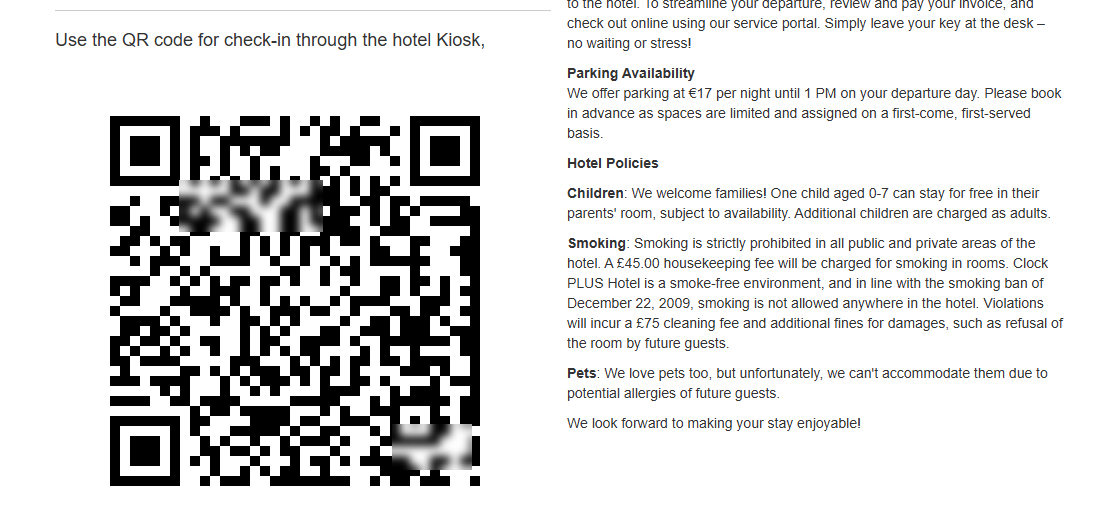
Guests can use this QR code to access their booking at the Kiosk. Alternatively, they can use another enabled login method.
2. Identifying the Guest at the Kiosk
When guests arrive at the property, they can identify themselves and locate their booking using one of the configured methods:
ID card or passport: Guests present their identity document to the Kiosk camera. Clock recognises the document, extracts the guest's name, and attempts to locate the corresponding booking.
QR code: Guests scan the QR code received in their confirmation email or other communication.
Booking number and PIN: Guests enter their reservation credentials.
Surname: Guests can locate their booking using their surname, if this method is enabled.
Identification Through an ID Card or Passport
The Kiosk can use the guest's identity document both to locate their reservation and to populate their registration details.
The process is straightforward:
The guest approaches the Kiosk, starts the process, and presents their ID card or passport to the camera.
Clock processes the document and extracts the relevant identification information.
The Kiosk attempts to match the guest's name with an existing booking.
Once the booking is identified, the extracted information is used to populate the guest's registration card.
The guest proceeds with the remaining check-in steps.
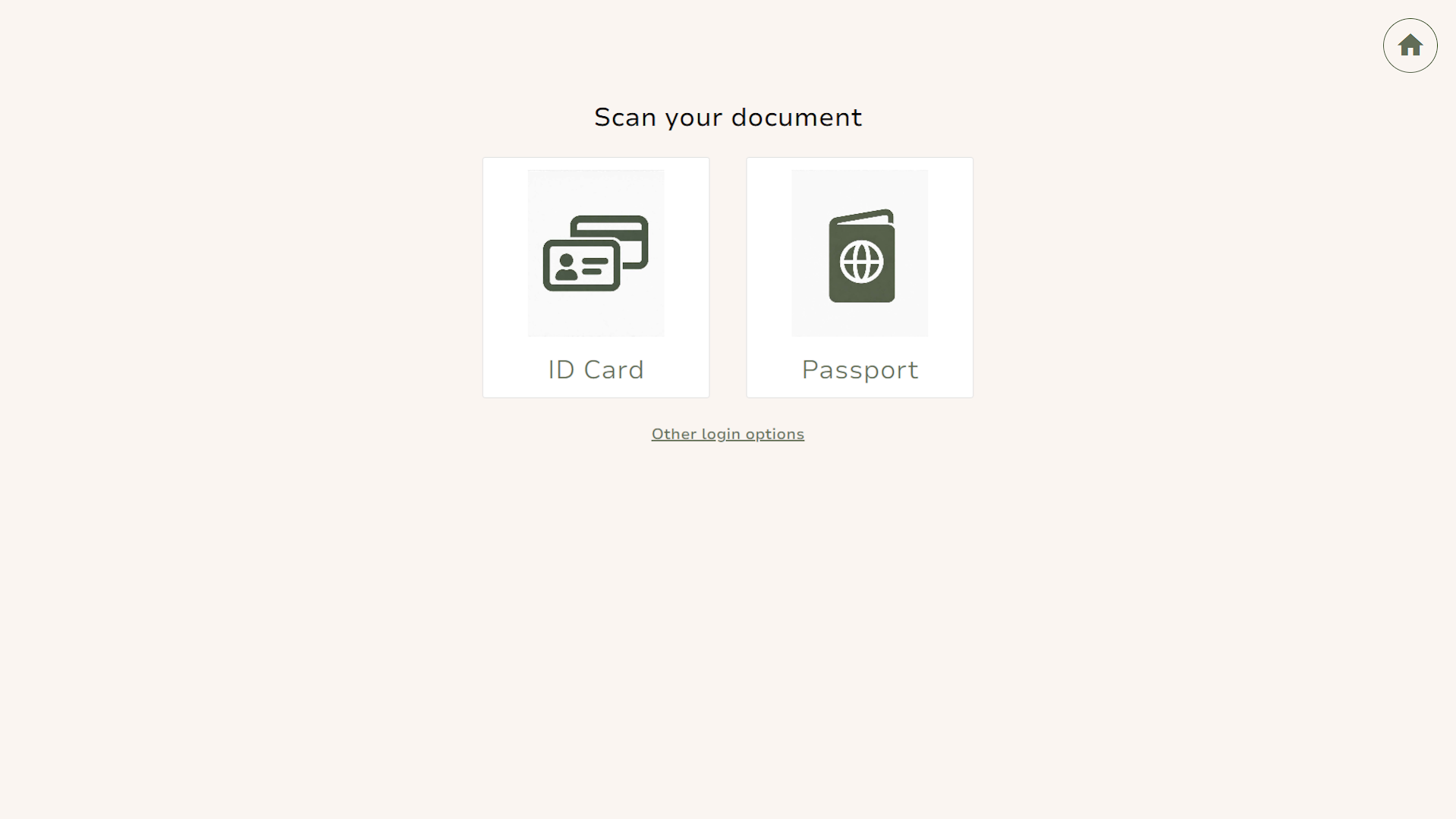
This method reduces the amount of information guests need to enter manually and simplifies the check-in process.
Important: If the name on the identity document does not match the name on the booking closely enough for automatic identification, the guest can use another enabled login method, such as QR code, booking number and PIN, or surname.
3. Completing Registration Cards
Guests can complete their registration cards either through Online Check-in before arrival or directly at the Kiosk.
Depending on your configuration, the Kiosk supports two methods of collecting registration details:
Manual entry: Guests enter the required information directly on the Kiosk screen.
ID document recognition: Guests present their ID card or passport to the camera, allowing Clock to extract and populate the available information automatically.
These methods can be enabled independently or together, allowing guests to complete their registration using the available options.
Registration Card Requirements
You can configure how many registration cards guests must complete for a booking.
The available options include:
One registration card per booking: Only the main guest needs to complete a registration card.
One registration card per adult: Each adult included in the booking must provide their registration details.
One registration card per guest: Every guest, including children, must have a registration card.
Duplicate Identity Document Verification
To help maintain accurate guest records, Clock prevents the same identity document from being used to register multiple guests within a single booking.
For example, if a booking requires registration cards for two adults, the same ID card cannot be used to complete both registrations.
This helps prevent situations where guests unintentionally or deliberately submit the same identity document for everyone in the booking.
The number of registration cards required depends on the configuration described above.
4. Online Check-in Before Arrival (Optional)
Guests who prefer to complete their registration before arriving can use Clock's Online Check-in.
Guests receive an Online Check-in link through the booking confirmation email or another pre-arrival communication.
They open the link and complete the required registration cards.
Registration details can be entered manually or extracted from an ID card or passport, depending on your settings.
Guests sign their registration cards and accept the applicable hotel terms and conditions, guarantee policies, and cancellation policies.
Depending on your requirements, guests may also need to settle outstanding payments or provide payment card details.
Once Online Check-in is completed, guests automatically receive the Hotel Pass email containing their QR code, which they can add to Apple Wallet or Google Wallet.
Read more about configuring the Hotel Pass template HERE.
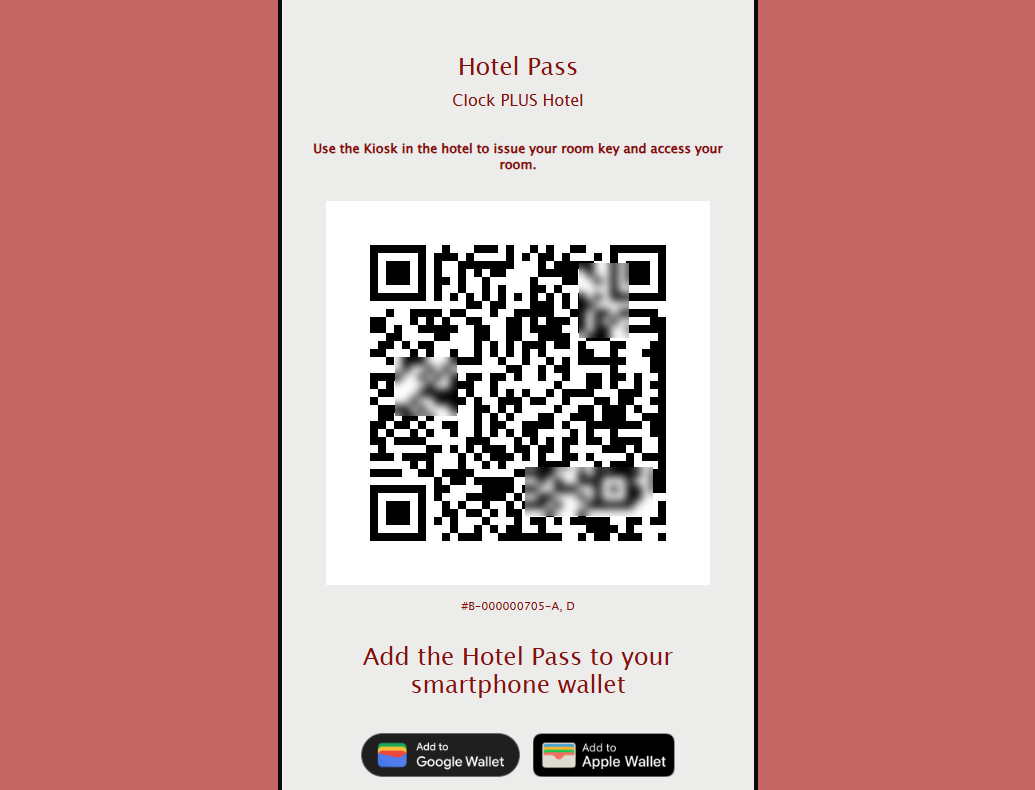
At this stage, the booking remains in Expected status but is marked as Online Checked-in.
When the guest arrives, they can identify themselves at the Kiosk and proceed with the remaining check-in steps.
Note: Completing Online Check-in before arrival is optional. Guests can also complete their registration directly at the Kiosk if the relevant functionality is enabled.
5. Payment at the Kiosk
Depending on your property's payment configuration, guests may be required to settle outstanding amounts before completing check-in.
If payment is required, the Kiosk guides the guest through the process using the connected payment terminal.
Once the payment has been completed successfully, the guest can proceed to the next step.
Important: If the guest has multiple open folios containing outstanding charges, each folio must be settled to complete the check-in process.
6. Room Allocation and Key Card Issuance
During check-in, Clock checks the room allocation and housekeeping status.
If no room has been allocated: Clock automatically selects a room from the booked room type that is available for the entire stay and marked as clean.
If a room has already been allocated: The room must be marked as clean for the Kiosk check-in to proceed.
If the allocated room is not clean: The guest is informed that the room is not yet ready and must wait before completing check-in.
For properties using compatible key card hardware, guests are prompted to collect and encode their room key card using the connected encoder.
Once all required steps are completed, the booking is checked in, and the guest can proceed to their room.
Re-issuing Room Key Cards
Guests can also use the Kiosk to issue another room key card during their stay.
To do so:
The guest identifies themselves at the Kiosk using an enabled login method.
They select the option to issue a key card.
The Kiosk guides them through the key card encoding process.
If the guest has been moved to another room during their stay, the Kiosk can issue a key card for the newly assigned room.
This allows guests to obtain another key card without requiring assistance from the front desk.
Self Check-out
The Kiosk can also be configured to allow guests to complete their check-out independently.
When Self Check-out is enabled:
The guest identifies their booking at the Kiosk.
Clock checks for any outstanding balances.
If payment is required, the guest settles the amount using the connected payment terminal.
Once all outstanding amounts have been paid, the guest completes the check-out process.
The folio is automatically closed and sent to the guest by email.
The booking status is updated to Checked-out.
This provides guests with a convenient departure option while reducing the need for front desk assistance.