The rules for automatic charge routing allow covering a wide range of real-world scenarios for corporate, group and individual bookings. In this article, you will find example configurations for the most common cases and guidance on how to implement them through routing rules.
Note: The examples below assume that you are familiar with the setup and use of routers. If you are not, see:
Example configurations
Guest pays everything, accommodation is charged to the Company
The guest pays all charges, but two separate documents are required: the package (accommodation and meals) to be charged to the Company, and the additional services – to the guest.
Objective:
The package services should be separated into a separate folio in the booking, with the Company as the recipient, and all other charges should remain in the main folio of the booking.

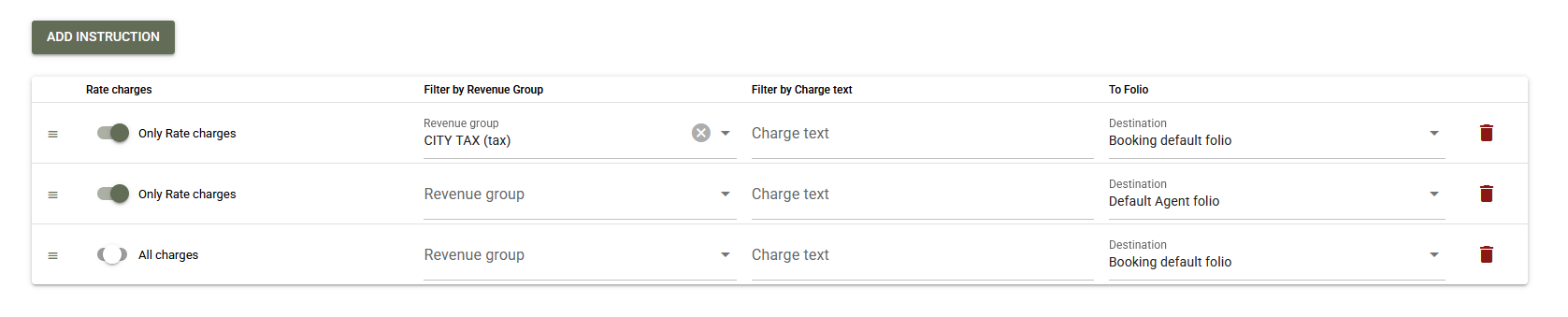
Guest pays everything, separation of City Tax
The guest pays everything. The booking is created via a channel manager and includes a virtual card, the amount of which only covers the accommodation. The City Tax is paid on the spot, together with the additional services.
Objective:
The City Tax should be separated into a separate folio, so that the task from the Payment Autopilot can successfully charge the virtual card and close the accommodation folio.
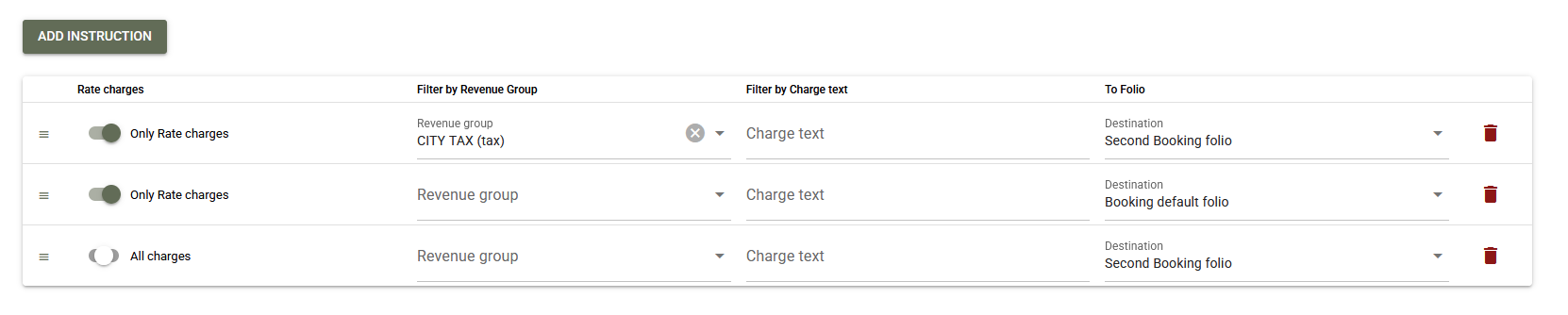
Company pays for accommodation, Guest pays for additional services.
The company pays for the package, and the guest – for all additional services.
Objective:
The package services should be transferred to the main company folio, and the additional charges should remain at the guest's expense.

Company pays for accommodation, invoices are organised by voucher number
The company pays for the package, with invoicing by voucher number.
Objective:
The package charges should be transferred to the company's folios, with a separate folio being created for each reference (voucher) number.

Company pays for accommodation, invoices are organised by arrival date
The company pays for the package, and the invoicing is organised by arrival date.
Objective:
The charges from the package should be transferred to the company's folios, with a separate folio being prepared for each arrival date.

Important: When changing the arrival date of an existing booking, it is possible that some of the charges will remain in the original folio.
Example: The booking was originally for a period of 10/07 – 25/07 and subsequently changed to 15/07 – 30/07.
In this case:
- the charges for the period 15/07 – 24/07 will remain in the original folio prepared for the date 10/07;
- charges for the period 25/07 – 29/07 will be directed to the new folio created for the date 15/07.
Reason: The charges are routed at the time they are created. When the period is changed, some of the charges have already been created, routing is not re-applied to them and they remain in the folio to which they were originally routed.
Solution: To avoid splitting charges across different folios after changing the arrival date, use the “Re-Route charges” function available on the reservation screen.

Agent pays for accommodation, Guest pays City Tax and additional services
The agent pays for the package, and the City Tax and all additional services are paid by the guest.
Objective:
The package services should be transferred to the main Agent folio, and the City Tax and additional charges should remain in the booking folio.